Category: Uncategorized

  • Which Metal for Custom Earrings? Titanium, Steel, Silver, Brass, and Zinc

    Which Metal for Custom Earrings? Titanium, Steel, Silver, Brass, and Zinc

    Before you choose a shape, a plating color, or a decoration method, you choose a base metal, and that single decision quietly sets everything after it: whether the earring is safe against sensitive skin, how heavy it feels in the lobe, whether it tarnishes on a shelf, how it takes plating, and a good part of what it costs. Five metals cover almost every custom earring run: titanium, 316L stainless steel, sterling silver, brass, and zinc alloy. They are not interchangeable, and the right one depends on what your line is trying to be.

    The nickel question comes first

    Nickel allergy is the most common metal sensitivity, so skin safety is where a custom earring line should start, especially because it is regulated. Under the EU’s REACH rules, an item in direct and prolonged contact with skin must not release more than 0.5 micrograms of nickel per square centimeter per week, and the stricter limit for a post inserted into a pierced ear is 0.2 micrograms per square centimeter per week. Compliance is measured with a standard artificial-sweat test, EN 1811. If you sell into Europe, or simply want to make an honest hypoallergenic claim, these numbers are the bar to clear.

    Metals answer that question very differently. Titanium and niobium contain no nickel at all and are biocompatible, which is why they are the default for piercing studs and the most reactive customers. Sterling silver is also nickel-free, alloyed with copper rather than nickel. Surgical 316L stainless steel is the nuance: it does contain nickel, on the order of ten to fourteen percent, but the nickel is bound tightly in the alloy and release is usually low enough to pass, which is why so much body jewelry is 316L. It is not the same as nickel-free, though, and a small share of very sensitive wearers still react. Brass and zinc alloy are the wild cards, because their composition varies and they are almost always worn under plating; there the plating, not the base metal, is what touches skin, so plating quality and coverage decide whether the piece stays safe as it wears.

    Titanium and stainless steel: the skin-safe workhorses

    If durability and skin safety matter most, these two do the heavy lifting. Titanium is nickel-free, corrosion-proof, never tarnishes, and very hard, yet it is also the lightest of the common earring metals. That last point is easy to overlook and matters more than buyers expect: a large statement earring in a dense metal can tug at the lobe all day, while the same shape in titanium sits lighter. Implant-grade titanium (often Grade 23) is the version to specify for anything going through a piercing. The trade-off is cost and workability; titanium is the priciest of this group as a raw material and is harder to machine and plate, so intricate cast shapes are less natural in it.

    316L stainless steel is the value champion of durable metals. It resists scratching and corrosion, holds a bright finish without tarnishing, and costs far less than titanium or silver. Its main caveats are the nickel nuance above and its weight: stainless is roughly two-thirds heavier than titanium by volume, so a chunky stainless design can feel substantial. For everyday earrings that need to survive drawers, showers, and years of wear at a sensible price, it is hard to beat.
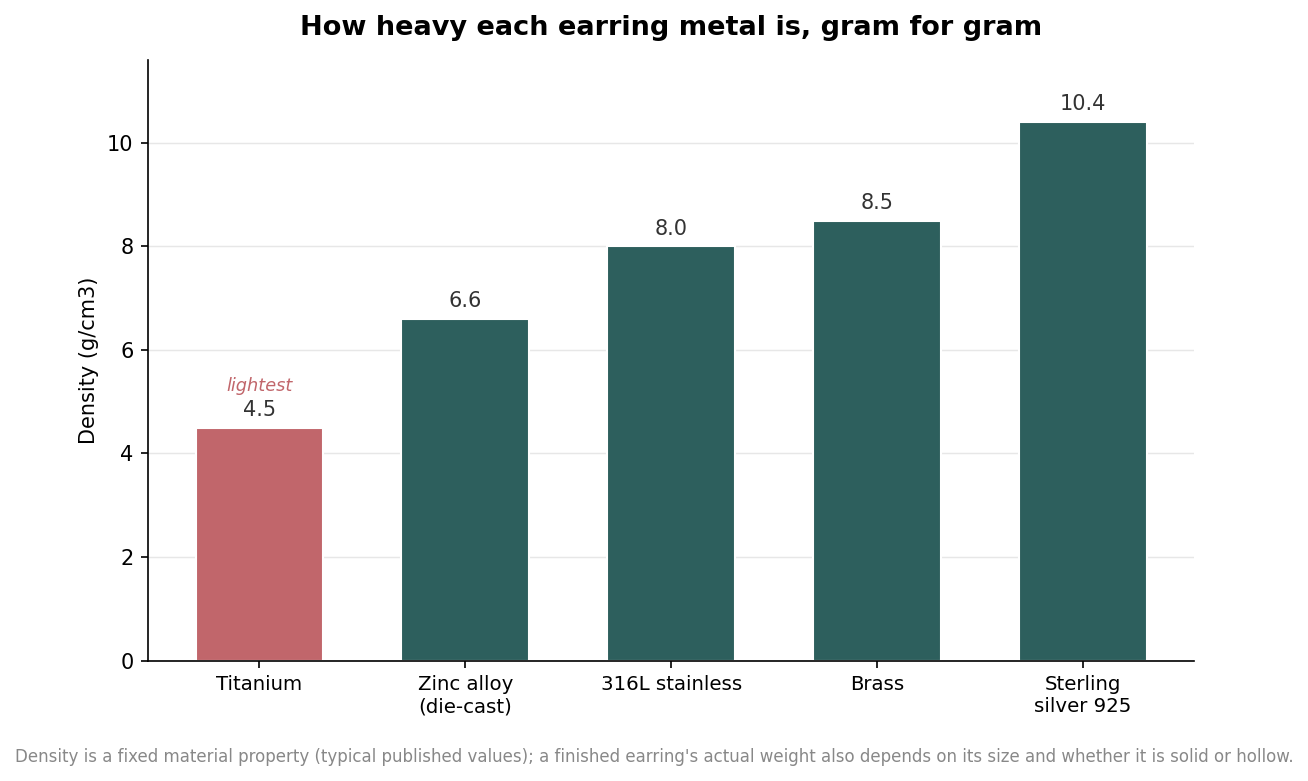
    Bar chart of earring metal density in grams per cubic centimeter: titanium 4.5, zinc alloy 6.6, 316L stainless 8.0, brass 8.5, sterling silver 10.4
    Material density by metal, the physical reason titanium earrings feel lighter than silver ones.

    The weight chart above is a material property, not a finished-piece weight, but it explains a lot of the comfort difference between metals. Density does not change; a cubic centimeter of sterling silver simply weighs more than twice what the same volume of titanium does. How you use that fact depends on the earring: for small studs it barely registers, but for hoops and large drops it is the difference between all-day comfort and something that gets taken off by lunchtime.

    Sterling silver: the precious-metal option

    Sterling silver, stamped 925, is 92.5 percent pure silver alloyed with about 7.5 percent other metal, usually copper. It is nickel-free and reads as a genuine precious metal, which is exactly its appeal for a premium or heirloom line where customers expect real silver rather than plating over a base. The two honest drawbacks are tarnish and softness. Silver oxidizes with exposure to air and moisture and will need occasional polishing, so it is less suited to a set-and-forget fashion piece and better for keepsakes people care for. It is also softer than steel or titanium and can bend or dent, which argues for slightly more substantial construction on thin components. On cost it sits above the base metals and stainless, below titanium as a raw material in the common ranking, and its price also tracks the silver market.

    Brass and zinc alloy: cheap, castable, and all about the plating

    Most inexpensive fashion earrings are built on brass or zinc alloy, and both can look excellent when finished well. Brass, a copper-zinc alloy, casts and stamps cleanly and gives plating a warm base, but it oxidizes and can contain traces of other metals, so it is essentially always plated and should never be a bare post against skin. Zinc alloy, the die-cast metal behind a lot of detailed charms and shapes, is the cheapest option and reproduces fine relief beautifully, but it is soft, must be plated, and depends entirely on that coating for both looks and skin safety. With either metal, the plating is the product: ask about the plating thickness and the underplating, because a thin flash will wear through at contact points and expose a base metal you did not want touching skin. Used well, plated brass and zinc deliver the lowest per-piece cost and the most freedom in shape; used carelessly, they are where tarnish and reactions come from.

    Choosing the metal for your line

    Match the metal to the positioning. For a sensitive-skin or piercing-focused line, specify titanium, or a verified-passing 316L or sterling for non-post components, and keep anything entering a piercing nickel-free. For a durable everyday line at a fair price, 316L stainless steel is the sensible default. For a premium or gift line where customers want a real precious metal, sterling silver earns its higher cost and its care requirements. For high-volume fashion at the lowest cost and the widest range of cast shapes, plated brass or zinc alloy is the answer, provided you hold the plating to a real standard.
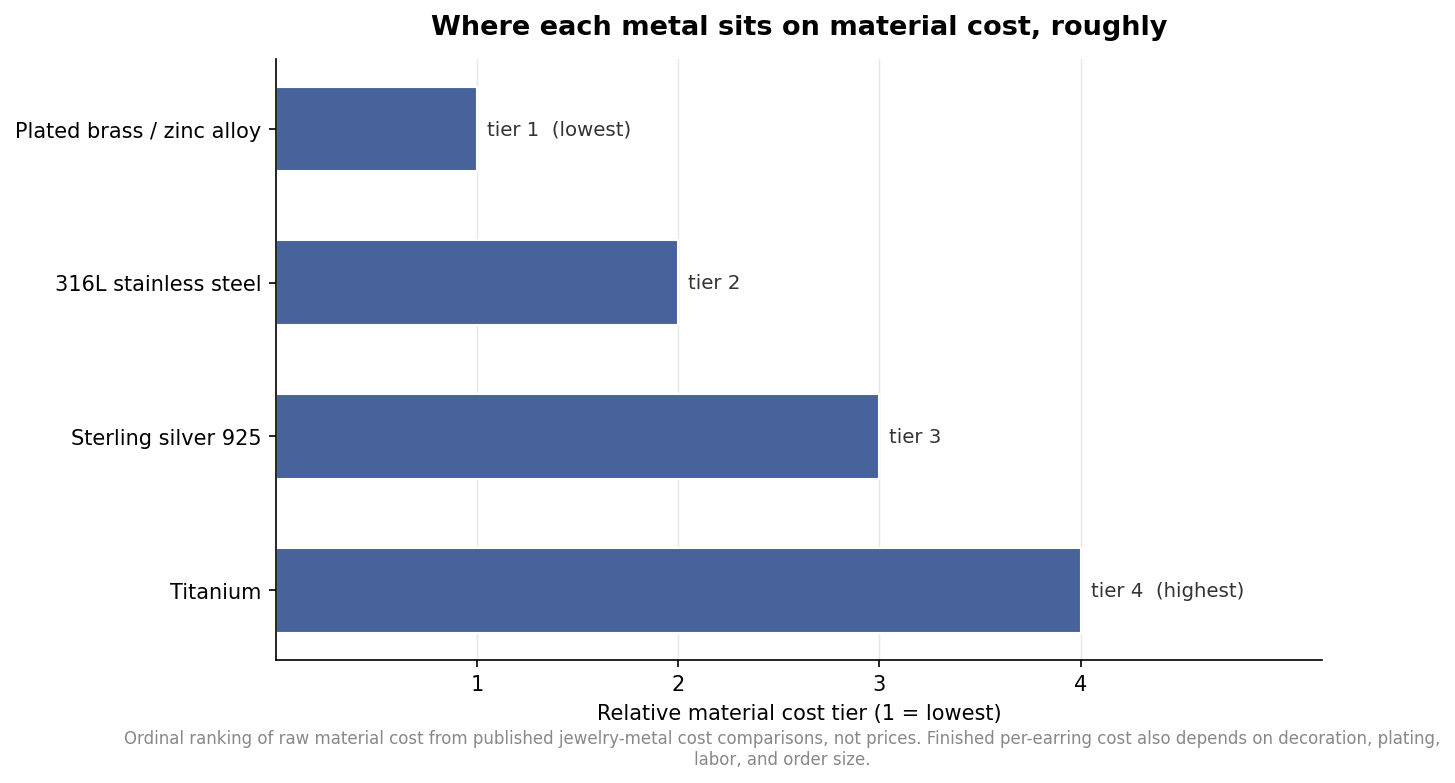
    Horizontal bar chart ranking raw material cost tiers: plated brass and zinc lowest, then 316L stainless, sterling silver, and titanium highest
    A rough ordering of raw material cost by metal; finished earring price depends on much more.

    The cost chart is a rough ordering of raw material only, not a finished-earring price, and that distinction matters when you plan a range. Decoration, plating, findings, labor, and order quantity often move the final number more than the base metal does, which is why a well-made plated brass earring and a stainless one can land closer in price than the raw materials suggest. Decide the two things that are hard to change first, skin safety and the weight your designs need, then let cost and finish steer the rest. Get the base metal right and the plating honest, and the plating color, shape, and decoration become the easy, creative part of the run.
  • Butterfly, Screw, or Lever: Choosing Earring Backs for a Custom Run

    Butterfly, Screw, or Lever: Choosing Earring Backs for a Custom Run

    On a custom earring order it is easy to spend all your attention on the front — the stone, the plating, the shape — and treat the back as a default. That is a mistake, because the back is the part the wearer interacts with every single day. It decides whether the pair feels secure, how long it takes to put on, whether a heavy drop tilts forward, and, multiplied across a production run, it moves your per-pair cost. Choosing the right back is a real specification decision, and it comes down to the earring’s weight, its style, and who is going to wear it.

    Friction backs: the default, and its ceiling

    The friction back, also called a butterfly or push back, is the small nut with two curled wings that slides onto the post and grips it by tension. It is the default for good reasons: it is inexpensive, discreet, quick to put on, and it fits virtually any standard post. For lightweight studs on ordinary lobes, it is perfectly adequate and it keeps the cost of a large run down.

    Its ceiling is security. Because it holds by friction alone, the grip relaxes with repeated use, and a back that has been pushed on and pulled off hundreds of times will eventually loosen and can slip free. It also gives a heavier earring nothing to lean on, so a friction back under a substantial stud lets the piece droop forward. If the earring is light and the price point is keen, friction backs are the sensible call; if the piece is valuable or heavy, they are the weakest link.

    Locking and screw backs: when losing one is not an option

    Two mechanisms solve the security problem in different ways. A La Pousette, or locking, back uses a pressure-activated spring: press the tabs, slide it onto the post, and it clicks into a locked position that is far less likely to loosen over time. It keeps a slim profile and stabilizes heavier earrings, which makes it a strong all-round upgrade. Its downsides are cost and dexterity — the little tabs can be fiddly for anyone with arthritis or limited fine-motor control.

    A screw back threads an ear nut onto a threaded post, so it cannot slide off at all without being unscrewed. It is the most secure option, its tightness is adjustable, and it is the right choice for heavy earrings, genuinely valuable stones, very active wearers, and children, where a lost earring is a real problem. The trade-off is time and expense: screwing a back on and off takes patience, and both the threaded post and the nut cost more to manufacture. For a custom run aimed at fine or children’s jewelry, that premium usually pays for itself in returns avoided.

    Lever backs and omega clips: built for weight and drops

    Studs are only half the catalog. For dangles, drops, and gemstone hoops, the back is often integrated into the finding itself. A lever back is a hook-shaped ear wire that passes through the lobe and snaps shut against a hinged lever, giving a drop earring a secure, self-contained closure that also disguises weight on the lobe. An omega back, or French clip, uses a hinged loop that presses against the back of the lobe and lends stability to heavier pieces, sometimes combined with a post. Both look refined and both suit weight better than a plain friction nut. Their limitations are that some wearers find the hinge awkward to fasten, and a protruding lever can occasionally snag on hair or clothing. When your design is a drop rather than a stud, one of these is almost always the right answer.

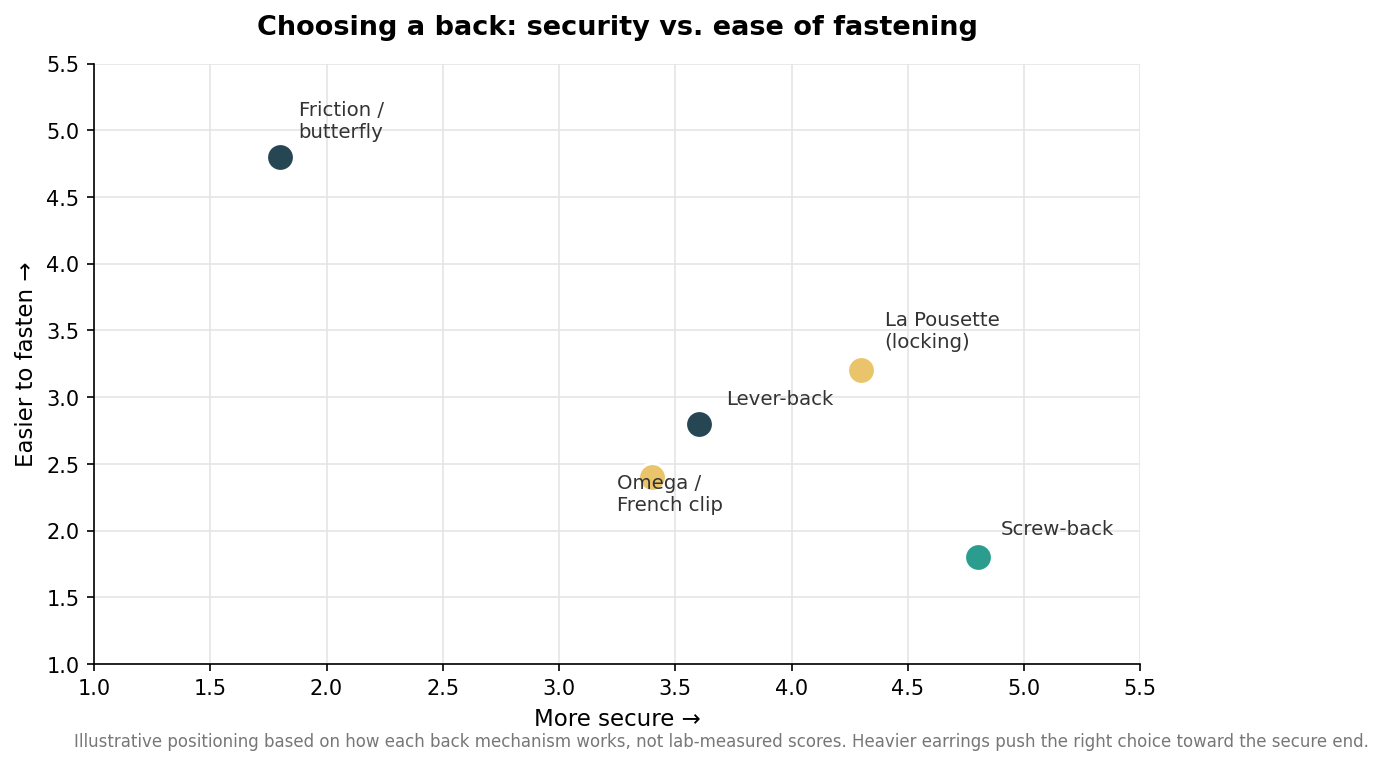
    Scatter plot positioning earring backs by security versus ease of fastening: friction easy but least secure, screw-back most secure but slowest, locking and lever in between
    An illustrative map of the trade-off; heavier or more valuable earrings should move you toward the secure end.

    The fit spec under the back: post gauge and length

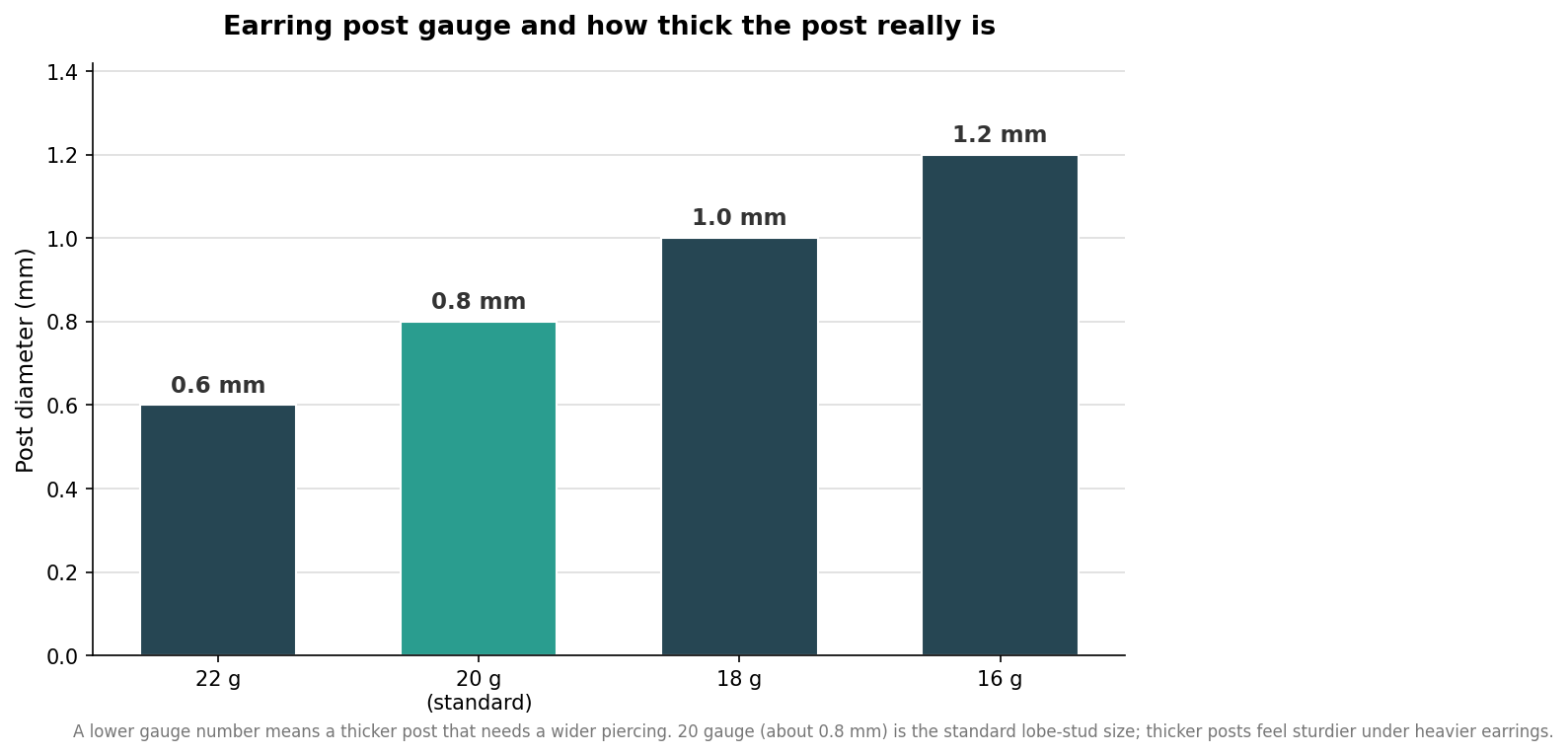
    The back can only be as good as the post it grips, and posts are described by gauge, the thickness of the wire. The standard for lobe studs is 20 gauge, roughly 0.8 millimeters, and that is what most piercings are sized for. A step thinner is 22 gauge at about 0.6 millimeters, while thicker posts run to 18 gauge at 1.0 millimeter and 16 gauge at 1.2 millimeters. A lower gauge number means a thicker, sturdier post, but it also requires a wider piercing, so going thicker is not a free upgrade — a 16 gauge post will not pass comfortably through a lobe pierced for a 20 gauge stud.

    For a custom run, the practical guidance is to stay at 20 gauge for general fashion studs so the earrings fit the piercings your customers already have, and to reserve thicker posts for heavier pieces that genuinely need the rigidity. Post length matters too: too short and the back cannot seat properly on a fuller lobe, too long and the earring wobbles. Specifying a standard post length with a small allowance covers most wearers.

    Bar chart of earring post gauge versus diameter in millimeters: 22g 0.6mm, 20g 0.8mm standard, 18g 1.0mm, 16g 1.2mm
    20 gauge, about 0.8 mm, is the standard lobe-stud post; thicker posts feel sturdier but need a wider piercing.

    Choosing backs for your run

    Work from the product, not the parts bin. For lightweight fashion studs sold at volume, friction backs on a 20 gauge post keep cost down and fit everyone, and offering a locking back as an upgrade is a low-effort way to add a premium tier. For heavier studs and anything with a real stone, default to a locking or screw back so the weight has support and the piece cannot quietly disappear. For drops, dangles, and hoops, design the closure in from the start with a lever or omega back rather than bolting a nut onto a straight post. And for two audiences in particular — children and anyone buying a genuinely valuable pair — screw backs are worth the extra manufacturing step, because the whole point of those pieces is that they do not get lost.

    One last consideration for a bulk order is consistency of experience. Mixing back types across a collection is fine, but keep the choice deliberate and matched to each style, and make sure the back metal is the same quality as the front, since a nickel-bearing nut can undo the comfort of an otherwise skin-friendly earring. Get the back right and the earring simply works every day, which is exactly the impression you want a customer to keep.

  • What “Hypoallergenic” Has to Mean on an Earring

    Roughly one person in eight reacts to nickel, and most of them check before buying. That makes ‘hypoallergenic’ a commercially valuable word — and it is not a regulated one, which is exactly why it is used so loosely.

    Nickel is the issue, almost always

    Contact dermatitis from jewelry is overwhelmingly a nickel reaction. Nickel is present in most stainless steels, in many white gold alloys, and in the base metal under a great deal of plated jewelry.

    Plating over a nickel-bearing base delays the problem rather than solving it: once the plating wears through at a contact point, the wearer is in contact with nickel.

    The two materials that reliably work

    Implant-grade titanium is inert, extremely light and used for surgical implants. It is the right answer for freshly pierced ears, children and anyone with a known reaction.

    316L surgical steel contains a small amount of nickel but bound in a way that releases negligibly, and it is fine for the large majority of sensitive wearers. It is considerably cheaper, and being clear about which one a product uses matters.

    The clutch is the component everyone forgets

    A titanium post with a standard nickel-bearing butterfly back is not a hypoallergenic pair. The clutch sits against the back of the earlobe for as long as the earring is worn.

    Specify the complete finding — post, clutch, and any connecting components — in the same material. Ask your supplier to confirm the clutch specifically; the answer tells you a lot about the rest.

    Sterling and gold, briefly

    Sterling silver is 92.5 percent silver with the balance usually copper, and is generally well tolerated. Solid gold above about 14 karat is usually fine, though white gold alloys sometimes contain nickel.

    Neither is as reliably safe as titanium for a known reactive wearer, and neither should be described as hypoallergenic without qualification.

    What to print on the card

    The material, specifically: ‘implant-grade titanium posts and clutches’ or ‘316L surgical steel, nickel free’. That is checkable and it is what a sensitive customer is actually looking for.

    ‘Hypoallergenic’ on its own increasingly reads as marketing. Naming the material reads as confidence.

    What we do

    Complete findings in one specified material, stated on the quote and printed on the card. If you are building a sensitive-skin range, tell us at the quote stage so it is specified from the start rather than substituted at the end.

  • Micron Thickness: Why Two Identical-Looking Gold Earrings Age Differently

    Two gold-tone earrings can look identical in a photograph and be an order of magnitude apart in how long they last. The difference is measured in microns, and almost nobody publishes it unless asked.

    What a micron actually buys you

    Plating thickness is measured in microns — thousandths of a millimeter. Flash plating at 0.175 to 0.5 microns is a color coat and nothing more; it wears through at contact points within weeks of regular wear.

    Heavy gold plate at 1 to 2.5 microns lasts months to a year or two. Vermeil at 2.5 microns and above over sterling survives years of regular wear. Same appearance, entirely different product.

    The base matters as much as the layer

    Gold over brass will eventually show brass, which is yellow-ish and reads as tarnished rather than as a different metal. Gold over sterling shows silver, which reads as a deliberate two-tone and is far less obviously worn.

    This is why vermeil specifies a sterling base. It is not snobbery about the underlying metal, it is about what the piece looks like at the end of its life.

    Where wear actually happens

    Not evenly. Plating goes first at the points that rub: the back of a stud where it meets the clutch, the edge of a hoop that sits against the ear, the highest point of any raised texture.

    That means a flat polished piece and a heavily textured one wear very differently at the same plating thickness, which is worth thinking about at the design stage rather than after.

    What you can honestly print

    ‘Gold vermeil’ if it is at least 10 karat gold, at least 2.5 microns, over solid sterling. ‘Gold plated’ otherwise, at any thickness. ‘Gold tone’ if it is a coating that is not gold at all.

    Regulators and customers both increasingly know the difference. Getting the plating thickness stated on your quote is a two-minute email that protects the claim on your card.

    Caring for it, and telling customers

    Plating is worn away mechanically far more than chemically. Removing pieces before swimming, sport and sleeping extends life dramatically, and a short care line printed on the back of the card genuinely changes how long the product lasts in the wild.

    We print care lines as standard because a customer whose earrings lasted is a customer who comes back.

    What we do

    2.5 micron minimum on anything we call vermeil, over solid sterling, with the thickness stated on the quote. Heavier plating on request where a piece will see hard wear. And we will tell you plainly when a target price only works as plate, rather than quietly thinning the gold to hit it.

  • The Complete Buyer’s Guide to Custom Earrings

    Ordering jewelry wholesale means navigating a vocabulary designed to be flattering rather than precise. Several of the most common terms have real definitions that most products described with them do not meet.

    This guide gives you the definitions and the four decisions that actually determine whether a customer buys from you twice.

    Solid metal versus plated base

    Solid sterling is 92.5 percent silver throughout. It can be polished back after years, it will not wear through to something else, and it is what ‘silver jewelry’ means to a customer.

    Silver-plated base metal is brass or zinc with a thin silver layer. It looks identical on day one and wears through at the contact points. Both are legitimate products at different price points; the mistake is describing one as the other.

    Vermeil has a specification, and most vermeil is not

    Vermeil requires gold of at least 10 karat, at least 2.5 microns thick, over a solid sterling silver base. All three conditions.

    Gold over brass is gold plate however thick. Flash plating at half a micron over sterling is gold plate too. If you are going to print the word on a card, get the plating thickness in microns stated on your quote.

    The finding is the part touching skin

    A sterling earring on a plated steel post is not a nickel-safe pair, and the post is the only part actually inside the piercing. This is the single most common corner cut in the trade.

    For a hypoallergenic claim you need the whole finding — post, clutch and any connecting components — in implant-grade titanium or 316L steel. Ask specifically about the clutch; that is where it usually falls down.

    When acrylic is the right answer

    For a mascot, a museum motif, a state outline or anything with a distinctive silhouette, laser-cut acrylic gives you shapes metal cannot at a price that moves at a stall. Mirrored sheet reads metallic at a fraction of the cost.

    It is not a downgrade, it is a different product. Trying to make metal hit an acrylic price point is how you end up with thin plating over brass.

    Enamel: soft versus hard

    Soft enamel leaves the raised metal lines standing above the color — textured, traditional, slightly cheaper. Hard enamel is polished flat to a smooth glassy face and reads as the premium option.

    Both hold color permanently because it sits in recessed metal cells rather than on the surface. Tooling is a one-time cost, so plan a range rather than one design at a time.

    Packaging is not optional if you are selling retail

    A pair in a bag is a component. On a printed card with a barcode, a care line and a metal statement, in a sealed poly bag, it is a product a shop can hang on a hook.

    Have them assembled and sealed at the factory. Receiving loose pairs and a box of cards means somebody spends a week with a hole punch, which is where the saving disappears.

    What to send us

    Your design or a sketch, the metal you want, roughly how many, and whether you need retail packaging. If you are making a nickel-free claim, say so up front so we specify the whole finding rather than just the post.