On a custom earring order it is easy to spend all your attention on the front — the stone, the plating, the shape — and treat the back as a default. That is a mistake, because the back is the part the wearer interacts with every single day. It decides whether the pair feels secure, how long it takes to put on, whether a heavy drop tilts forward, and, multiplied across a production run, it moves your per-pair cost. Choosing the right back is a real specification decision, and it comes down to the earring’s weight, its style, and who is going to wear it.
Friction backs: the default, and its ceiling
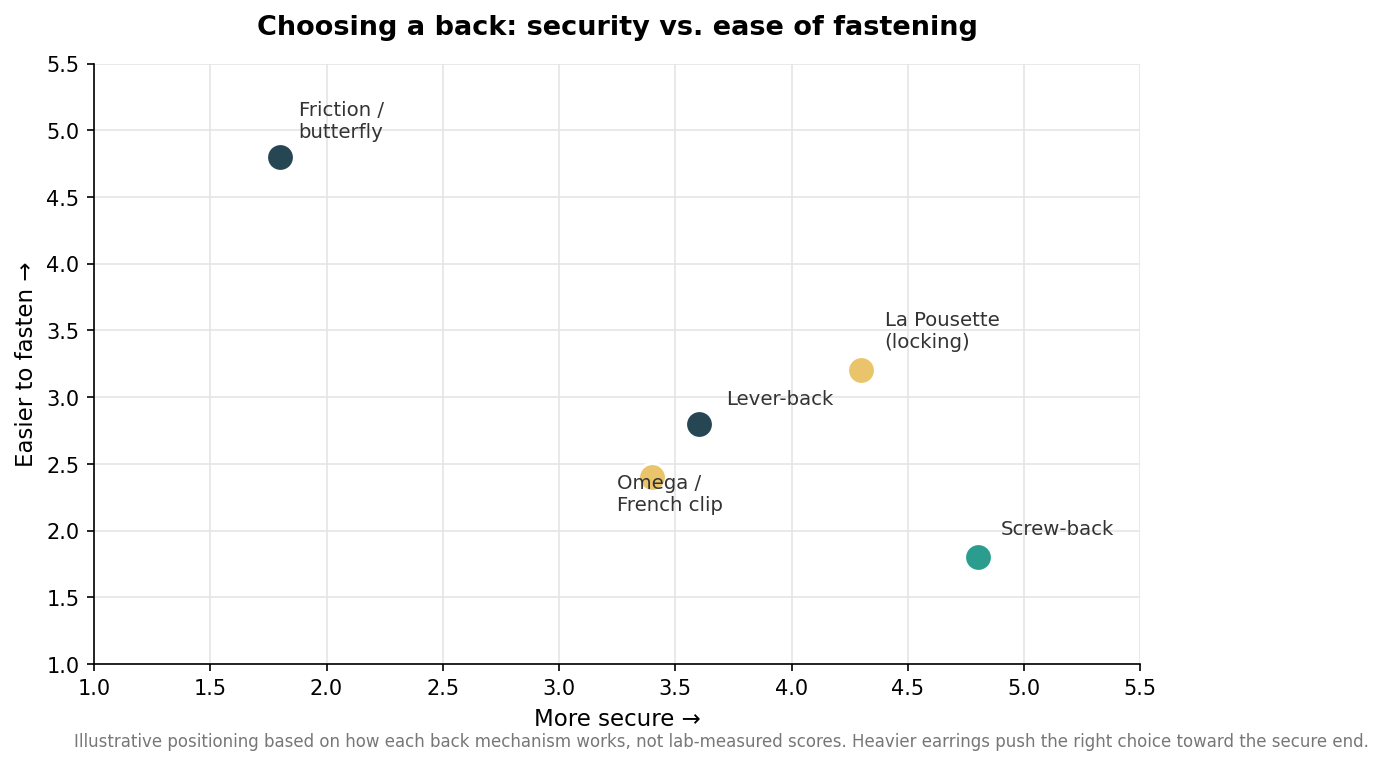
The friction back, also called a butterfly or push back, is the small nut with two curled wings that slides onto the post and grips it by tension. It is the default for good reasons: it is inexpensive, discreet, quick to put on, and it fits virtually any standard post. For lightweight studs on ordinary lobes, it is perfectly adequate and it keeps the cost of a large run down.
Its ceiling is security. Because it holds by friction alone, the grip relaxes with repeated use, and a back that has been pushed on and pulled off hundreds of times will eventually loosen and can slip free. It also gives a heavier earring nothing to lean on, so a friction back under a substantial stud lets the piece droop forward. If the earring is light and the price point is keen, friction backs are the sensible call; if the piece is valuable or heavy, they are the weakest link.
Locking and screw backs: when losing one is not an option
Two mechanisms solve the security problem in different ways. A La Pousette, or locking, back uses a pressure-activated spring: press the tabs, slide it onto the post, and it clicks into a locked position that is far less likely to loosen over time. It keeps a slim profile and stabilizes heavier earrings, which makes it a strong all-round upgrade. Its downsides are cost and dexterity — the little tabs can be fiddly for anyone with arthritis or limited fine-motor control.
A screw back threads an ear nut onto a threaded post, so it cannot slide off at all without being unscrewed. It is the most secure option, its tightness is adjustable, and it is the right choice for heavy earrings, genuinely valuable stones, very active wearers, and children, where a lost earring is a real problem. The trade-off is time and expense: screwing a back on and off takes patience, and both the threaded post and the nut cost more to manufacture. For a custom run aimed at fine or children’s jewelry, that premium usually pays for itself in returns avoided.
Lever backs and omega clips: built for weight and drops
Studs are only half the catalog. For dangles, drops, and gemstone hoops, the back is often integrated into the finding itself. A lever back is a hook-shaped ear wire that passes through the lobe and snaps shut against a hinged lever, giving a drop earring a secure, self-contained closure that also disguises weight on the lobe. An omega back, or French clip, uses a hinged loop that presses against the back of the lobe and lends stability to heavier pieces, sometimes combined with a post. Both look refined and both suit weight better than a plain friction nut. Their limitations are that some wearers find the hinge awkward to fasten, and a protruding lever can occasionally snag on hair or clothing. When your design is a drop rather than a stud, one of these is almost always the right answer.
The fit spec under the back: post gauge and length
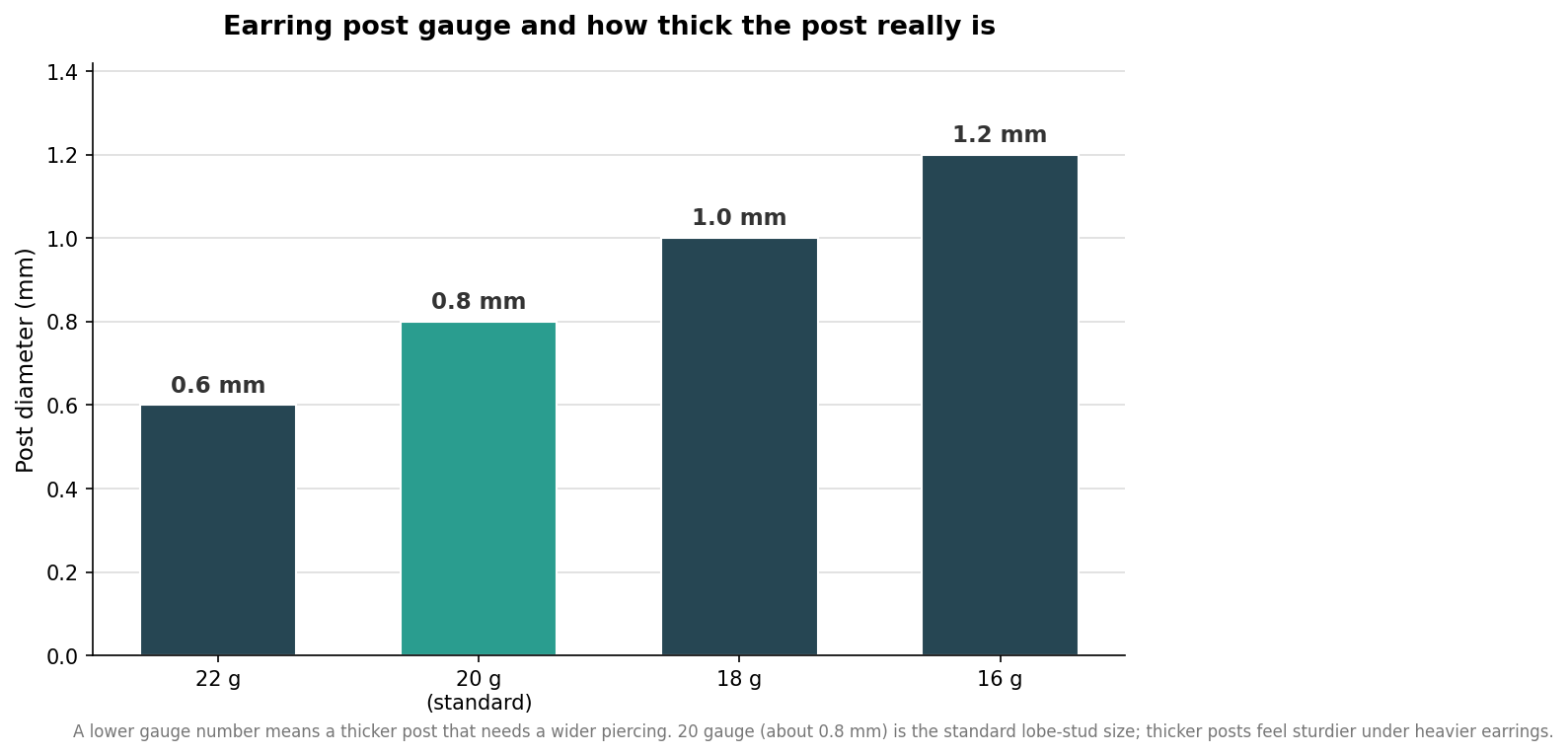
The back can only be as good as the post it grips, and posts are described by gauge, the thickness of the wire. The standard for lobe studs is 20 gauge, roughly 0.8 millimeters, and that is what most piercings are sized for. A step thinner is 22 gauge at about 0.6 millimeters, while thicker posts run to 18 gauge at 1.0 millimeter and 16 gauge at 1.2 millimeters. A lower gauge number means a thicker, sturdier post, but it also requires a wider piercing, so going thicker is not a free upgrade — a 16 gauge post will not pass comfortably through a lobe pierced for a 20 gauge stud.
For a custom run, the practical guidance is to stay at 20 gauge for general fashion studs so the earrings fit the piercings your customers already have, and to reserve thicker posts for heavier pieces that genuinely need the rigidity. Post length matters too: too short and the back cannot seat properly on a fuller lobe, too long and the earring wobbles. Specifying a standard post length with a small allowance covers most wearers.
Choosing backs for your run
Work from the product, not the parts bin. For lightweight fashion studs sold at volume, friction backs on a 20 gauge post keep cost down and fit everyone, and offering a locking back as an upgrade is a low-effort way to add a premium tier. For heavier studs and anything with a real stone, default to a locking or screw back so the weight has support and the piece cannot quietly disappear. For drops, dangles, and hoops, design the closure in from the start with a lever or omega back rather than bolting a nut onto a straight post. And for two audiences in particular — children and anyone buying a genuinely valuable pair — screw backs are worth the extra manufacturing step, because the whole point of those pieces is that they do not get lost.
One last consideration for a bulk order is consistency of experience. Mixing back types across a collection is fine, but keep the choice deliberate and matched to each style, and make sure the back metal is the same quality as the front, since a nickel-bearing nut can undo the comfort of an otherwise skin-friendly earring. Get the back right and the earring simply works every day, which is exactly the impression you want a customer to keep.